
Have you ever been stuck trying to explain something complex and thought, “I need a good example right about now”? Well, you’re not alone! In our day-to-day conversations, writing, and even professional communications, using examples is like having a secret weapon that makes your point crystal clear.
I’ve been writing and teaching for years and I can tell you that mastering the phrase “for example” (and its fancy Latin cousin “e.g.”) can transform your communication skills practically overnight.
What Exactly Does “For Example” Mean?
“For example” is a phrase we use when we want to illustrate a point by providing a specific instance or case that represents a broader category. It’s essentially saying “Here’s one instance that demonstrates what I’m talking about.”
According to the Cambridge Dictionary, “for example” is used “when giving an example of the type of thing you mean.” It’s considered an A1-level phrase, meaning it’s one of the most fundamental expressions in English communication.
The phrase helps us to
- Clarify abstract concepts
- Support arguments with evidence
- Make complex ideas more relatable
- Add specificity to general statements
How to Use “For Example” in Sentences
Using “for example” correctly can really elevate your writing. Here’s how it typically appears in sentences:
-
After a general statement:
“Offices can easily become more environmentally friendly by, for example, using recycled paper.” -
At the beginning of a sentence:
“For example, writers have always used metaphor. Cicero compared the human figure to a vase.” -
In the middle of a list:
“Many of the things he loved as a child – for example candy and cartoons – still give him pleasure.” -
To introduce practical applications:
“There are some simple changes you can make for a healthier life. For example, you could take the stairs instead of the elevator.” -
To illustrate a point with contrast:
“Try to keep your training positive. For example, instead of punishing your dog for misbehavior, instead praise them for obeying a command.”
“For Example” vs. “E.g.” – What’s the Difference?
Now, here’s where things get a bit interesting! Many people get confused between “for example” and its Latin abbreviation “e.g.” (which stands for exempli gratia).
According to Merriam-Webster, “e.g.” means exactly the same thing as “for example.” It’s used before an item or list of items to provide examples of what you’re talking about.
For instance:
- “Set an immediate timeline, e.g., three weeks, to learn all this.”
- “The original soapmaker Emanuel Bronner was no more a doctor than the fictional Dr Pepper, but I certainly relate to the bizarro messages fine-printed on his products, e.g., ‘Smile, help teach the whole Human race, the Moral ABC of All-One-God Faith, Lightning-like string & we’re All One!'”
Don’t Confuse “E.g.” with “I.e.”!
This is a common mistake I see all the time! Many people confuse “e.g.” (for example) with “i.e.” (that is). They serve different purposes:
- E.g. = “for example” (introduces examples)
- I.e. = “that is” (clarifies or restates)
Let me break down the difference with some examples:
Using i.e. correctly:
“Some swing States, such as Pennsylvania, Michigan, and Wisconsin, are from the ‘Rust Belt’ — i.e., they were industrialised but have seen industrial decline and relative urban decay since.”
Using e.g. correctly:
“I enjoy outdoor activities, e.g., hiking, kayaking, and bird watching.”
A helpful tip: If you’re unsure which to use, try substituting the phrase with “that is” or “for example.” If “that is” fits, use “i.e.”; if “for example” fits, use “e.g.”
Punctuating “For Example” and Its Variations
Proper punctuation helps maintain clarity when using these phrases:
For “For Example”:
- Generally followed by a comma
- Often set apart with commas when in the middle of a sentence
- Can be followed by a colon when introducing a list
For “E.g.”:
- Usually followed by a comma
- Often enclosed in parentheses or brackets
- Can follow a comma or em dash
For “I.e.”:
- Also usually followed by a comma
- Similarly enclosed in parentheses or brackets
- Can follow a comma or em dash as well
Practical Examples in Different Contexts
Let’s see how “for example” works across different situations:
In Academic Writing:
“Several factors contribute to climate change; for example, deforestation reduces the Earth’s capacity to absorb carbon dioxide.”
In Business Communication:
“We need to improve our customer service metrics. For example, we could reduce response time and increase follow-up contacts.”
In Technical Documentation:
“This software has multiple export options. For example, users can save files as PDFs, JPEGs, or SVG formats.”
In Casual Conversation:
“I’ve tried lots of ways to relax after work. Reading a good book, for example, helps me unwind.”
Common Mistakes to Avoid
Even experienced writers sometimes make these mistakes:
-
Using “i.e.” when you mean “e.g.”
- Incorrect: “I enjoy many fruits, i.e., apples and bananas.”
- Correct: “I enjoy many fruits, e.g., apples and bananas.”
-
Forgetting the comma after “for example”
- Incorrect: “For example the sky appears blue because of light scattering.”
- Correct: “For example, the sky appears blue because of light scattering.”
-
Using “ex.” as an abbreviation for “example”
- This isn’t standard in formal writing. Stick with “e.g.” or “for example”
-
Overusing examples
- One or two clear examples are usually better than a long list
“For Example” in Different Languages
If you’re working in multiple languages, it’s helpful to know the equivalent phrases:
- French: “par exemple”
- Spanish: “por ejemplo”
- German: “zum Beispiel” (abbreviated as “z.B.”)
- Portuguese: “por exemplo”
- Chinese (Simplified): “例如” (lì rú)
Why Good Examples Matter in Communication
I’ve noticed that the quality of your examples can make or break your communication. A good example should be:
- Relevant – directly relates to the point you’re making
- Clear – easily understood by your audience
- Concrete – specific rather than abstract
- Familiar – something your audience can relate to
- Accurate – factually correct and not misleading
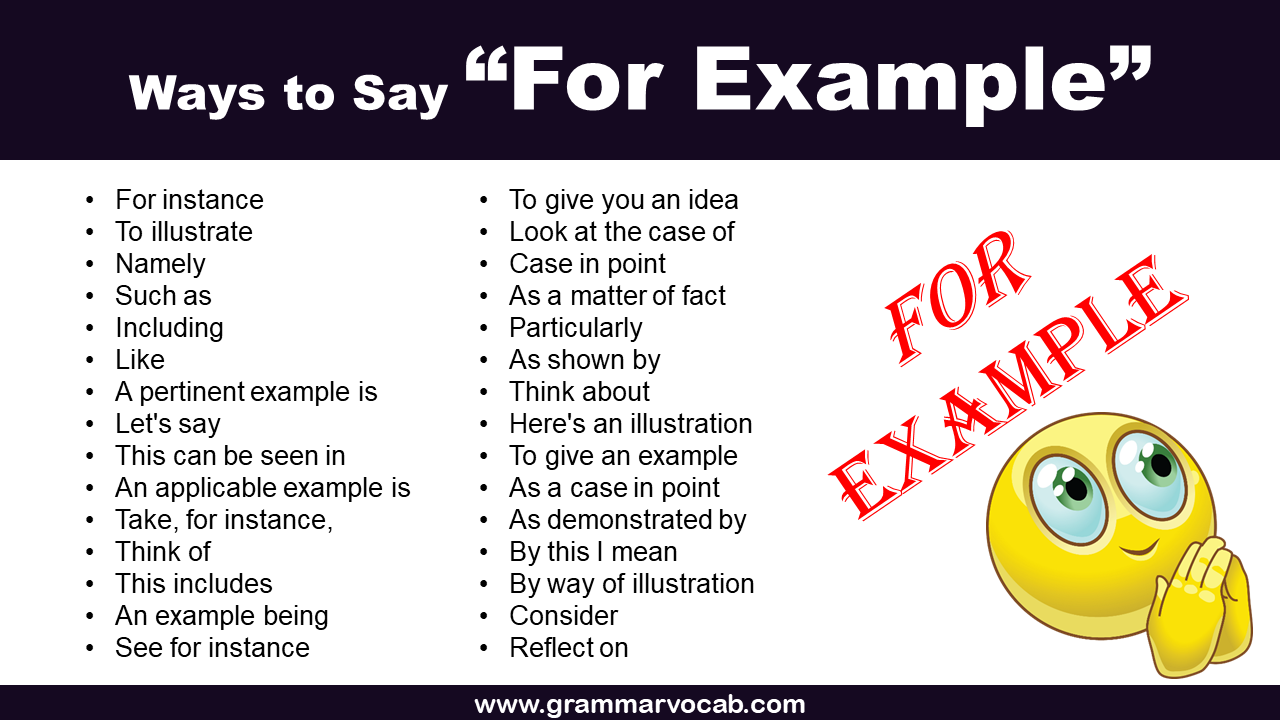
Alternative Ways to Introduce Examples
If you’re tired of saying “for example” all the time, here are some alternatives:
- “Such as…”
- “Including…”
- “Like…”
- “To illustrate…”
- “As an illustration…”
- “As a case in point…”
- “For instance…”
- “Namely…”
- “Specifically…”
Real-World Applications of Good Examples
We sometimes don’t realize how crucial good examples are in different aspects of life:
In Education:
Teachers who provide clear, relatable examples often have students who grasp concepts faster. For example, explaining gravity by dropping different objects helps students understand the concept visually.
In Marketing:
Case studies and testimonials are essentially extended examples that show potential customers how a product or service works in real life.
In Public Speaking:
Speakers who incorporate personal stories and examples tend to connect better with their audience and make their points more memorable.
In Technical Writing:
Clear examples in user manuals can significantly reduce customer support issues.
Tips for Crafting Perfect Examples
After years of writing, I’ve developed these strategies for creating effective examples:
- Know your audience – tailor examples to their knowledge and interests
- Be specific – vague examples confuse rather than clarify
- Use familiar scenarios – examples from everyday life are easily understood
- Keep it simple – overly complex examples defeat the purpose
- Consider using analogies – compare unfamiliar concepts to familiar ones
When to Avoid Using Examples
While examples are powerful, they’re not always appropriate:
- When time or space is extremely limited
- When the concept is already crystal clear
- When examples might be culturally insensitive or confusing
- When confidentiality is a concern
The Psychology Behind Examples
There’s actually some interesting science behind why examples work so well:
- Concrete processing – Our brains process concrete information more easily than abstract concepts
- Episodic memory – We remember stories and examples better than plain facts
- Pattern recognition – Examples help us see patterns and make connections
- Emotional connection – Good examples often trigger emotional responses, making them more memorable
In the end, using “for example” and providing good examples is about being considerate to your audience. It’s taking that extra step to ensure your message isn’t just delivered but truly understood.
Whether you’re writing an email, giving a presentation, or teaching a complex concept, remember that a well-placed example can transform confusion into clarity.
And remember – the difference between “e.g.” (for example) and “i.e.” (that is) is worth keeping straight. When in doubt, you can always substitute the full phrases to check which one fits!
So next time you’re struggling to make your point clear, think about what specific examples might help illustrate your message. Your audience will thank you for it!
Do you have any favorite ways to use examples in your communication? I’d love to hear about them in the comments below!
Kay Switch featuring Olamide & Wizkid – For Example (Remix)
FAQ
How do I use IE and EG?
How do you use for example correctly?
Note E.g. is often used in parentheses. In academic writing, we recommend using it only in parentheses and writing out “for example” in full in the main part of a sentence. Overuse of abbreviations, although it saves space, can make your sentences look messy.
What is the synonym for “for example”?
For Example’ Synonym Phrases
“For instance …” “To give you an idea …” “As proof …” “Suppose that …” “To illustrate …”
Is it ex or eg for example?